Showing posts with label Coastal Walking. Show all posts

Monday, 14 February 2011

Blowin away

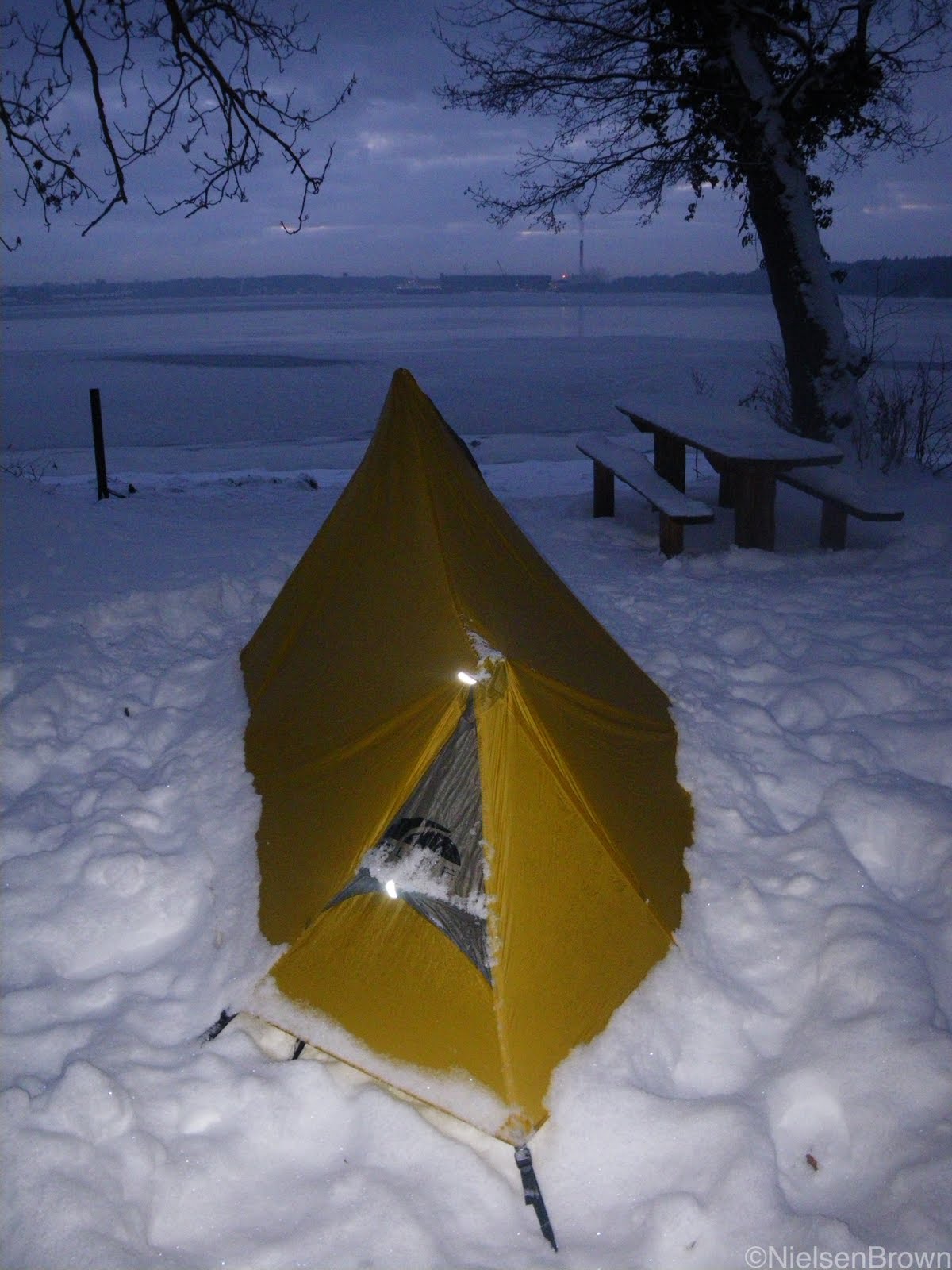
Alighting from the train I headed into Tornby Klitplantage and set up camp for the night it had been a cold clear and calm sunny day, sadly for me most of the day had been spent on the train.


The following morning I awoke to an ice encrusted shelter, having had breakfast I set off on the frozen ground towards the coast as the clouds gradually built with a breeze strengthening. I crossed Liver Å on the bridge and it was evident that any moisture in the sand had frozen whilst evidence of sand slips above the bridge ensured that every step was taken with care.


The trail took me through many summer house areas as it skirted the coast line and with the wind increasing the sun covered in cloud there was little time to hang around, it was cold. Finally descending and then walking along the beach to Lonstrup before heading through this quiet windswept village and once again turning south west towards the highlights of the days walk.


The coastline here is subjected to the force of the wind and the North Sea and as a result the coast line is forever changing and with many buildings gradually getting closer to the cliffs and ultimately disappearing. Such is the case with Mårup church originally built in the 1200's about a kilometre from the sea, it is now less than 10 metres from the sea.


To the south of the church lies Rubjerg Knude and accompanying light house, as I climbed to the top of the dune the windswept sand ensured that my face was kept buried in my Tuara.


Fortunately much of the sand was frozen and as such it was not too bad, I can however imagine the sand storms that must rage through this area at times.


The sand around the lighthouse was hollowed out making a veritable wind tunnel and it was interesting to see that the lighthouse originally built in 1899 was surrounded by outbuildings but now only the tower remained. The lighthouse was decommissioned in 1968 and the fight against the sand drifts was given up in 2002, once again demonstrating the power of nature.


Leaving the sand dune the trail descended into the peaceful sheltered tranquility of a small forest, it was here, sheltered from the wind, I had lunch.

The afternoon took me through Nørre Lyngby another town threatened by the encroaching sea.

Leaving Nørre Lyngby the trail followed the sea and I slipped and slid over many large ice patches on the sand (should have packed my micro spikes) while there was more evidence of the power of the sea over man made structures.


The cliffs provided some respite from the wind, however, it was evident that the wind was increasing and the accompanying windchill ensured the temps were dropping into the the negatives teens I decided that it was time to find a sheltered spot for the night and a small cabin seemed ideal. Having booked into the cabin, on the outskirts of Løkken, with forecasts of wind speeds ranging between 15 and 20 metres per second for the coming days and with temps below zero combined with a possible reoccurrence of an old injury I felt it was time to head home.

Some gear observations, the Haglöfs Ozo Pullover was perfect for such conditions and it has possibly the best hood of any jacket I have used.

The MLD Speed mid is an ideal size for one and provides enough space should the weather turn bad, this will be going on more trips.

For the trip I used the Snowpeak Gigapower Ti Stove and I used 20 gms of gas per litre of water.


I will be back, as there are many more beaches to walk.


Saturday, 1 January 2011

Gendarmstien: Padborg to Skelde Kobbelskov

The weather forecast for the week was for a little snow and clear cold conditions with temperatures ranging between -15 and -5 degrees C, it was to be a cold trip.

The Gendarmstien is a 74 km route from Padborg to Høruphav and follows the border between Germany and Denmark mostly along the coastline of Flensburg Fjord. The Gendarmstien was patrolled by Danish police between 1920 and 1958 and the path now forms part of the European Long Distance Route 6 (E6).

I set off from Padborg Station as large snowflakes began to fall, no doubt getting a few strange looks from the locals wondering why would anyone go backpacking at this time of the year. I soon realised that whilst many people had been out walking and the snow was only supposed to be 15 cm deep, it was very powdery and soft. It was grey and cold as I started along the Gendarmstien.


Once settled into my normal walking pattern I soon noticed the first of many Grænsesten each individually numbered and with a sighting line to the next Grænsesten in each direction.


However, there was also this strange object which looked like some form of listening post, I wondered if the Gendarme stood there listening to their favourite music? Anyone who has a suggestion on what this is I would be very appreciative of further information.


Soon after passing the "listening post" I came to one of the border gates now open for easy access, however, I can imagine in days gone by it was a lot more difficult to cross the border here.


Soon after passing the border gate I found myself on a section of the trail which was much less travelled and drifts of up to a metre were common as was "post holing" making for slow and tiring going. Snowshoes would have been useful but they did not arrive in time, sadly.

Fortunately though there was not too many drifts and I finally reached Kollund Skov my intended home for the night. The campsite provided a view across the fjord to the large city of Flensburg resplendent with its cathedral and ship building yards.


I required no encouraging to go to bed, it was cold out and I went to sleep to the sounds of sirens in Flensburg. In the morning I was awoken by the church bells, or was it the horns at the shipyards, not sure. It was still early as took a look around in the grey pre dawn, it was a calm morning.


After packing up, having had breakfast in bed, the luxury of it all, I was on my way and the sun began to make its presence known albeit weakly as I wandered through the beautifully wintery Kollund Skov.


The trail took me through the small township of Kollund Strand before heading inland to the snow encrusted Kollund Dyrehave.


As I headed east towards Rønshoved, I passed this beautiful ice and snow covered lake, magic.


Finally returning the fjord coastline a constant feature for much of the remainder of the walk.


The walk along the coast brought with it frozen ice and snow covered sand, which in most cases was okay for walking upon, but every so often a patch of ice hidden by snow would remind me to take care.


As I headed towards Dalsgård, I found some of the deepest drifts of the trip and with a fence on one side and tree covered cliffs on the other I was left with no option but to wade, crawl, though metre deep snow, fortunately this section was only about 100 metres in length. However, after passing through Stranderød I was informed by one of the locals that it was just as bad further along. I decided to try my luck on the beach but with the small ice covered rocks it was almost as bad, but different. Finally though I climbed away from the beach before descending again past the Dalsgård Fyr.


Climbing away from the beach the Dalsgård homestead glistened in the afternoon light and made for a very memorable sight.


After passing the homestead I followed the coastline before heading inland away from the Gendarmstien to the nights campsite Syvstjernen in Gråsten Skovene, as I entered the forest I noticed the owl inspecting my gear closely.


Syvstjernen, is a popular area and requires booking for groups at certain times of the year. Much to my surprise, 8 Danes arrived to stay the night, this was their third visit at this time of the year and I was the first person they had seen in those 3 years staying out here. They had carried their large packs about 500m from the car park and were fully provisioned for the night including Salmon for dinner. The -15C temperatures and the struggles for a decent fire ensured that we all retired early.

It was a bright, sunny cold morning as I headed off back to the trail via Gråsten before crossing the Egernsund Bridge.


On this cold clear day I passed by many old and new houses with views across the ice covered fjord to Germany. The marina was almost empty now but I could easily imagine the bustle of boats, people and vehicles during summer.


As I followed the coastline towards Brunsnæs there was plenty of evidence of wonderful ice sculptures brought about by the cold. There were many examples of what I dubbed "Ice Swans"


Fishing nets and boat moorings also provided ideal places for ice sculptures to grow.


Finally passing through Brunsnæs I left the coast and headed inland before turning east along a road, I was thankful that they had cleared this road as I could see myself still wading through snow until the thaw.


By now it was getting late and as I climbed towards Gammelgab the sun was beginning to set providing wonderful colourings on the ice.


As it was getting dark and with still a few kilometres to go it was a hasty walk with little time to take in the surrounds, but given tomorrow was the last day I had time to back track and visit some of the beaches again. I arrived at Skelde Kobbelskov to discover that most of the campsite was also a wind tunnel, fortunately I was able to find a small place out of the wind which still offered views of Sønderborg across Sønderborg Bugt.

It was a leisurely start the next morning and I was able to take the time to look at the ice covered trees suspended in the water, though the wind ensured that standing around for any length of time was not an option, so I headed off along the coast towards Kragesand.


With the wind came the cloud but the coast providing many fascinating scenes such as ice covered rocks.


Snow covered cliffs, I even wondered if there was a need for "avalanche warnings" as there was evidence that large lumps of snow had collapsed onto the beaches below.


Finally returning through Skelde Kobbelskov I came across the composition of fungi, timber and snow.


It was a cold, and at times challenging walk but one that was very enjoyable and therefore a walk I can see myself revisiting in winter or summer.

The waypoint map can be found here

Thursday, 21 October 2010

Wet and windy West Coast


Just back from a wonderful trip along the west coast of Jylland to Grenen, the top of Denmark. With magnificent beaches, beautiful autumnal forests and large migrating sand dunes, it was a very enjoyable trip. A report will follow in the coming days.

Monday, 8 March 2010

Torekov gear testing


Like Hendrik, I had the chance to get away for a quick over night trip. The focus of the trip was very much on testing some gear for up coming longer trips. I chose the location of my last visit the Bjärehalvön Penisula to explore and with temps around negative 10 at night it would be a good test of the clothing and sleeping gear. However, I was more interested in using the MLD Trailstar for its first trip along with the Aarn Marathon Magic 33.

After alighting from the bus I headed through the quiet streets of Torekov, these streets would normally be very busy in summer but at 10 am on a cold friday morning it was quiet. I sat for a while looking out to sea and watching a large Coast Guard vessel pass between the mainland and Hallands Väderö (in Swedish). It was then south along the coast with a calm sea to right, the sun in my face and the ground covered in snow or frozen water. The ice patches were thick and slippery and care was required with every step, however, I was soon warming up in the sunshine regretting not having packed either sun glasses or a peak caped.

A short stop allowed me to take a look at the view and made me realise how beautiful the coast was in the winter sunshine.


The remainder of the day passed uneventfully with my mind on the evening campsite and beginning to wonder how far below the surface would the ground be frozen, would I be able to get a peg in the ground, why did I not pack some Ti nails, would the water pump be working .... As I walked it was also obvious that very few people were out, even the dog walkers were noticeable for the absence.

I arrived at camp and quickly grabbed a 9” Easton alloy stake and started walking around pushing it into the ground, some spots were rock hard and others were less so, finding a spot on the east side of the trees to get the early morning sun and I set up the trail star, it was an easy task and though it required some adjustment I was pleased with the speed of the set up and reflected upon how in wet weather it would be easy to get some shelter quickly.


Having set up camp layed out my bivy and mattress, I spent some time just looking out to sea and enjoying the last of the afternoon sunshine.


A wander around the area soon found enough firewood for the stove and as the sun began to set I started a fire in the caldera inferno to cook dinner.


By the time dinner was finished, the sun was setting behind Kullaberg Naturreservet and the air was cooling. I wandered around for a while enjoying the peace, only punctuated by the bird song from Inre Gryteskär. I headed to bed and was soon asleep, as the night wore on even with a 1/4" Gossamer Gear Thinlight under my neo air there was some sense of coolness but I was never cold and slept till about 7:30 before the sun begun to brighten an already bright Trailstar, I love the yellow colour.

After breakfast in bed I set about packing up and after a further hours walk I was at the bus stop and 4 hours later at home.

It had been a very pleasant and relaxing walk and whilst it was old ground the scenery and the relaxing environment ensured a pleasant trip and one that I will happily do again.


Gear:
As has been stated by other authors, the MLD Trailstar is a great shelter, it is spacious, easy to erect, packs small, and has ample space to move around inside as well as offering a variety of pitches. For this trip I used a ID eVent Overbag wth the Therma rest neoair inside and the Gossamer Gear Thinlight (1/4" inch mat) underneath on a thin silnylon ground sheet. In warmer weather I probably use a BPL Vapor bivy or Six Moon Designs Meteor bivy for insect protection as well as a draft stopper.

I used a BPL 550 pot partnered with a Ti Tri Caldera Compact Inferno built for the MLD 850.

The pack as mentioned previously was the Aarn Marathon Magic 33 litre pack, I will provide a more detailed report of this pack in a later blog, however, I was very happy with it and enjoyed the experience of carrying the pack.

Thursday, 31 December 2009

Coastal walking in winter: Ängelholm to Torekov


I alighted from the train at Ängelholm after a 2 hour trip from Copenhagen, there was a light dusting of snow on the ground and the prediction was for temperatures around -5 C with little wind and clearing skies, the next day was to be even colder. I was on familiar ground as I had walked much of this trip before but it seemed like an appropriate walk for a quick get away. I was soon in the forest walking on frozen ground with my pacer poles barely sinking into the earth, I was quickly reminded of the challenge of frozen puddles and the options for ice skating, fortunately I was able to stay standing. The forest walk passed uneventfully with the occasional dog walker looking at me and probably wondering why I was carrying a sleeping mat as no sane person would camp out in this weather. This was the first trip for a while where I had a sleeping mat (Thermarest Ridge Rest) strapped to the outside of my Gorilla pack and there were several times i was asked was I camping out in such cold weather, not a common occurrence I assume in these parts. Soon it was into the summer houses area with many vacant houses with more sliding along icy roads. This section is perhaps the most uninteresting with bitumen bike paths trapped between the railway line and the coastline and as the wind picked up and the sleet began to fall it was not much fun but I knew that soon I would be on the trails passing through the coastal forest.

The forested section though short provided a little shelter from the wind and sleet and allowed for a lunch stop combined with a mist shrouded view of Kullabergs Naturreservat


After lunch the sleet had stopped but the wind was still cool so walked the rest of the afternoon in my Haglöfs Oz Pullover, feeling comfortably warm, however, I did notice some minor condensation inside at the end of the day. I continued north westward along the coast through the large coastal village of Vejbystrand clearly a popular area in summer but deserted now. After which it was about 3 kilometres to camp in the vicinity of Gryteskär shelter, located adjacent to a number of small rocky island which form part of the Bjärekustens naturreservat and are a protected bird sanctuary. However, as soon as the Hilleberg Soulo was up, it began to snow lightly so dinner was prepared on the gas stove in the tent. After dinner it had stopped snowing and I spent the remainder of a very still evening listening to different bird songs.


The next morning was very cool, with a thin layer of ice on the tent and the ground crunching under the feet. The section from Gryteskär to Torekov is mostly off road and follows the cost line within Bjärekustens naturreservat, a narrow strip of land separating the sea from the farming and summerhouse areas. Along this part of the coast there were swans, ducks as well as other sea birds happily drifting with the currents and feeding.


As the sun rose above the horizon, the clouds could be seen clearing further to the south and east and eventually the sun arrived where I was, it did nothing to increase the temperature, the reverse really.


The further along the coast there is less houses and the coastline also becomes rockier, however the views in the clear cold air were wonderful and with no wind it was a pleasure to be out on such a day.


The remainder of the walk was across frozen ground interspersed by the occasional ice covered small lake or stream all ensuring that care was taken when walking whilst appreciating the views.


This is an area of great beauty and on my two visits one in summer and one in winter have ensured that I will return again as there is so much to see and so much space that it is possible to have your own little bit of the coastline.

Have a great new year everyone

Sunday, 13 December 2009

Tisvilde Hegn


Tisvilde Hegn lies approximately two hours to the west of Copenhagen and can be reached by public transport, with the promise of sunshine I was keen to visit this area. Aside from wonderful beaches, and forests there are a number of historic sites. I set off from the railway station through the quiet village ( it is much busier in summer) and headed towards the coastline. The sun had only just risen but the temperatures were still below zero.


With no map and no real plan I headed south along the coastline walking up down the dunes, admiring the coast, the inland forests and the sun gradually climbing above the trees, occasionally walking on crunchy sand which had not felt the warmth of the sun. After about an hour I headed inland to Troldskoven with its wonderful pine trees, illuminated in the early morning sunshine.


Continuing south I arrived at one of the southern parking areas and collected a Vandreture folder which allowed me to plan my return path to Tisvildelejre railway station. But first I decided to visit Asserbo Slotsruin (castle ruins) with its idyllic moat.


After passing by a well used shelter place with its view of a mud covered frozen lake it was time to look for a spot to have lunch. The bushbuddy was soon out and a pot of noodle soup soon took away the chill in the air. After lunch I wandered through some beautiful stands of birch as well as pine forest before arriving at Torup Landsby (village).


Torup Landsby consisted of 16 farms and was deserted when large sand drifts in the 16th to 18th century took away the the land owners livelihoods. Excavations by volunteers in the 1960's and 70's led to the discovery of pottery and a coin from about 1320, indicating the long history of the village.


After leaving the remnants of Torup Landsby it was a pleasant stroll through the forests before arriving back in Tisvildelejre, it had been a very enjoyable day with the diversity of scenery combined with historic sites. I will be back as there is still much to see here and there will always be the sea to provide that calming effect.